World Mental Health Day Lived Experience: Real Voices, Real Change
It's World Mental Health Day 2026, and this week we will be sharing some of our staff experience with mental health recovery and how they use their experience in their role at the college.
First we will be sharing a Q&A with our colleague Sarah.
Sarah is a Facilitator at The Recovery College where she delivers courses and supports student's during their time at the college.
Would you feel comfortable sharing a little about your mental health journey and what led you to where you are today?
My mental health journey started at a young age and had many struggles throughout my child and teenage years, my diagnosis came in my 20s and it finally helped me understand my experiences up until then. The diagnosis in a way set me free , it allowed me to understand, accept and move on. My experience has underpinned every educational decision and every employment role I have taken on since. I used to see it as a burden, sometimes I still do – but most of the time now I see my experience as gift that I can use to help others. That is what has led me into this field of work.
What does recovery mean to you personally, and has that definition changed over time?
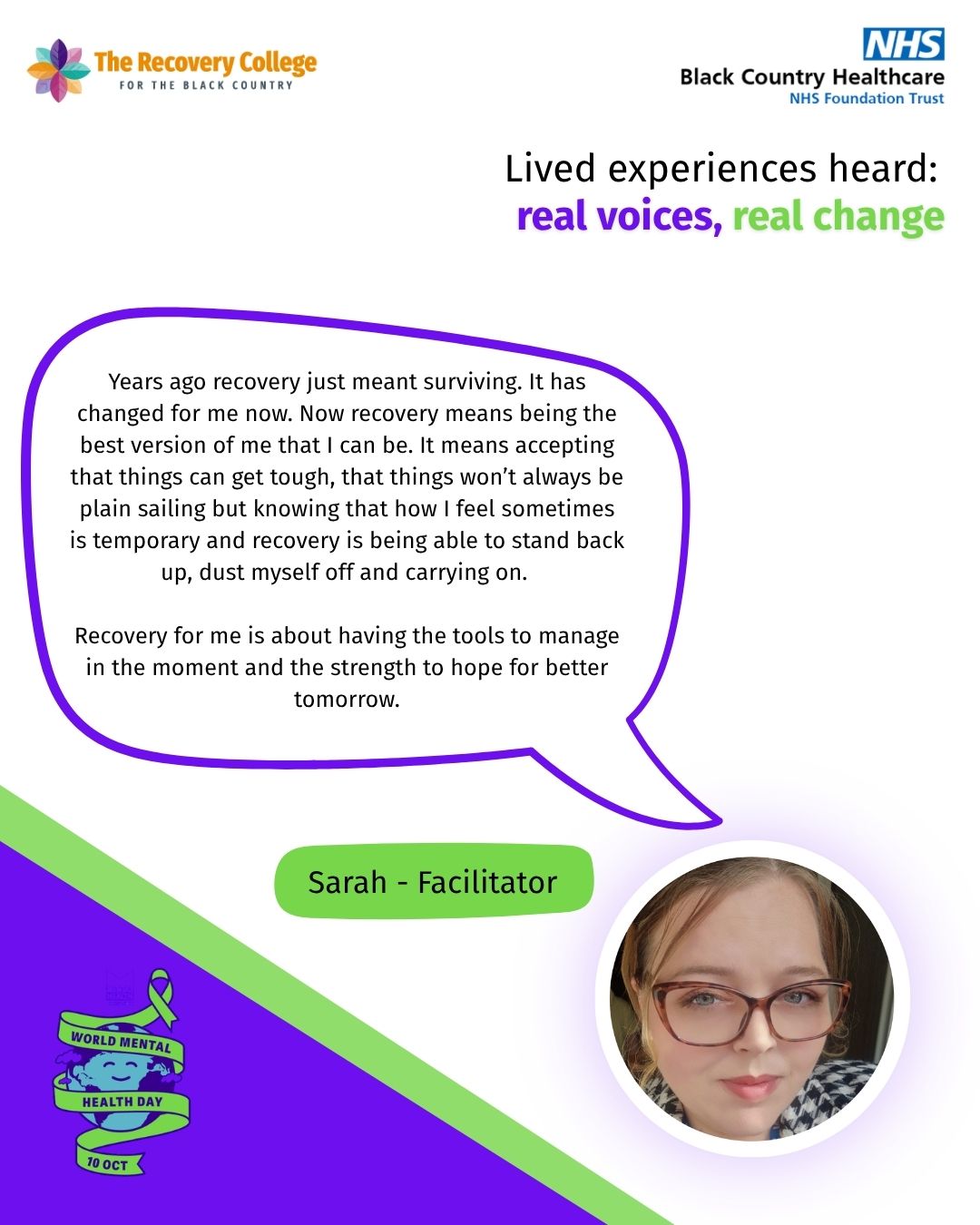
Years ago recovery just meant surviving. It has changed for me now . Now recovery means being the best version of me that I can be. It means accepting that things can get tough , that things won’t always be plain sailing but knowing that how I feel sometimes is temporary and recovery is being able to stand back up, dust myself off and carrying on. Recovery for me is about having the tools to manage in the moment and the strength to hope for better tomorrow.
What people, services, activities, or strategies have been most important in supporting your recovery?
My children have been very important in helping me in my recovery, but also extended family and friends. I have had to learn to un-learn negative habits and change my mindset, which wasn’t an easy task but activities and services like; mindfulness, self- care and coping skills programmes run through the NHS have been integral parts of supporting my recovery. Lastly, but not least, my job role. My role continues to support me through my own recovery as I try to offer support to others through theirs.
What strengths or qualities have you discovered in yourself through your experiences?
Definitely resilience ! Also, compassion and empathy , kindness and understanding . I also discovered a strong quality in educating and advocating.
How has your lived experience influenced your decision to work in mental health or related services?
Yes definitely. Having been through my own struggles and knowing how difficult navigating life can be , made me eager to find work in mental health. I wanted to help become a kind of beacon to people who were struggling, to show them that we can be better, we can recover and we are capable of whatever we put our minds to . Mental health can be unforgiving in allowing us to believe that we are unworthy of the things we wish for, I wanted to show people that this is not true.
In what ways does your personal experience help you connect with and support others in your professional role?
My personal experience gives me the understanding , the ability to empathise and understand with struggles people can face. It also provides opportunity because I know what has helped me in similar circumstances and this can prove to be so valuable sometimes. I am someone who loves to connect with others especially if through that connection I can offer some support, some skill sharing and signposting - all of which come from lived experience. This is something that has really helped within my professional role.
What do you wish people understood better about mental health, recovery, or lived experience?
Mental health is like being on a train, sometimes the boards glitch and the destination is unclear, but the train is on a track and moving forward. Sometimes we need to get off the train and get on a connecting one and when we get off we might need to stop and re-fuel. Refuelling might look like accessing a service, getting some support, learning some new skills . After a while we feel we are ready to get back onto the train, sometimes the destination is a little clearer – sometimes we have to stop and refuel all over again. Ultimately, our train takes us closer to where we want to go as long as we can accept that we may need to access some support from time to time, and that’s okay!
----------------------------------------------------------------------------------------------------------------------------------------------
If you need urgent support for your mental health, please contact NHS 111 Option 2.
There are also other helplines you can contact
CALM - Campaign Against Living Miserably Call 0800 58 58 58. The helpline is open 5pm - midnight every day.
Samaritans - 116 123 (24 hr helpline)
https://www.therecoverycollege.co.uk/the-rc-hub/crisis-support