To wrap up Stress Awareness Week we want to signpost you to support that you can access.
Stress is usually a reaction to mental or emotional pressure, You might find it hard to explain to people why you feel this way, but talking to someone could help you find a solution.
When it comes to stress relief, what helps one person might not help another. And different tools can be more, or less, useful for us at different times.
In the NHS you can seek help by referring yourself for therapy. NHS Talking Therapies offer support for anxiety and depression. You can refer yourself for free without seeing a GP.
Samaritans has a 24-hour helpline, open every day of the year. Call 116 123.
You can also visit Samaritans - find a local branch near you https://www.samaritans.org/wales/how-we-can-help/contact-samaritan/visit-us-branch/
You should see your GP
-
if you're struggling to cope with stress
-
things you're trying yourself are not helping
-
you would prefer to get a referral from a GP
At The Recovery College we offer a variety of courses to support mental health. One course that may benefit you is "Reducing overwhelm and managing demands". This course covers topics such as learning practical strategies for managing competing demands through pacing, planning, and protecting your energy, how to prioritise without pressure, regain control, and create a personalised toolkit to make life feel more manageable.
If you'd like to learn more about this course please contact us -https://www.therecoverycollege.co.uk/contact-us
An analogy we use at The Recovery College is the Stress Bucket.
"The stress bucket represents your ability to handle stress, pressure and challenges in your life. Above the bucket are rain clouds (stressors) — the aspects that are causing you stress and gradually filling up your bucket. Everyone’s stress bucket and rain clouds are different. If you can’t control the rain clouds, the only way to reduce the level in your stress bucket is to let water out. Taps at the bottom of the bucket represent your coping strategies. Once these taps are turned on, the water can return to a manageable level again
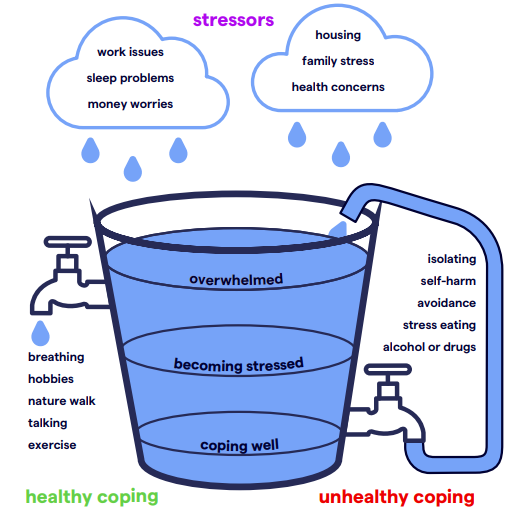
At times, you might engage in unhealthy coping strategies which provide short-term relief from stress. These strategies may briefly reduce the water but it can flow back in again. Being aware of these unhelpful coping strategies will help you understand how to avoid them and find other ways to cope. Often, we underestimate how well we cope and the skills we’ve developed to maintain the levels in our bucket. By using this tool to reflect on your coping strategies you may highlight an area you could address or understand further."
This explanation was written by Mental Health UK. You can access the file here: